
Understanding Currency Pairs: Essential Guide for Traders
Master currency pair fundamentals and discover the most suitable pairs for your trading strategy
1. Currency Pair Fundamentals
In forex trading, currency pairs form the cornerstone of every transaction. Unlike stocks where you buy shares of a single company, forex involves buying one currency while simultaneously selling another. Understanding how to read and interpret currency pairs is fundamental for anyone entering the forex market.
How to Read Currency Pairs
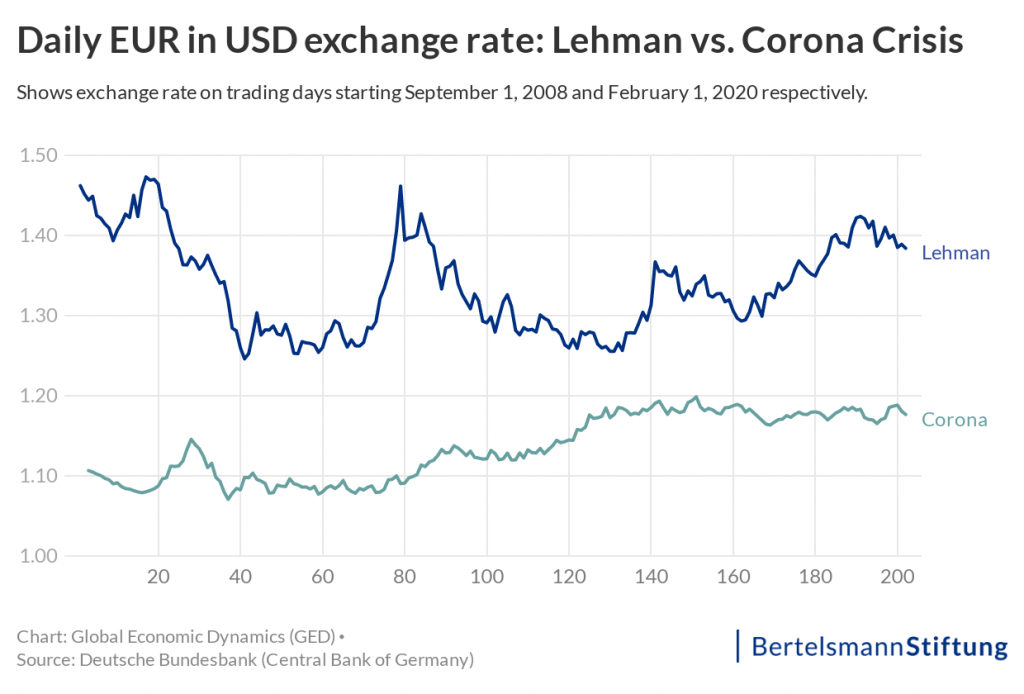
All currency pairs consist of two currencies separated by a forward slash. Let's examine the world's most traded pair: EUR/USD.
• EUR (Euro) = Base Currency
• USD (US Dollar) = Quote Currency
• Current Rate: 1.0850 means 1 Euro equals 1.0850 US Dollars
Base Currency vs Quote Currency

The base currency is always the first currency mentioned (left side) and represents one unit of that currency. The quote currency (right side) shows how much of this currency is needed to buy one unit of the base currency.
When you see EUR/USD = 1.0850, you're looking at how many US dollars (quote) are needed to buy one Euro (base). If the rate increases to 1.0900, the Euro has strengthened against the dollar.
Bid Price, Ask Price, and Spread
Currency pairs are quoted with two prices:
- Bid Price: The price at which you can sell the base currency
- Ask Price: The price at which you can buy the base currency
- Spread: The difference between bid and ask prices
Understanding Pip Values
A pip (percentage in point) is the smallest price movement in a currency pair, typically the fourth decimal place. For most pairs, one pip equals 0.0001. Japanese Yen pairs are exceptions, where one pip equals 0.01.
Pip values determine your profit or loss per pip movement. For standard lots (100,000 units), each pip typically equals $10 for USD-quoted pairs.
2. The Seven Major Currency Pairs
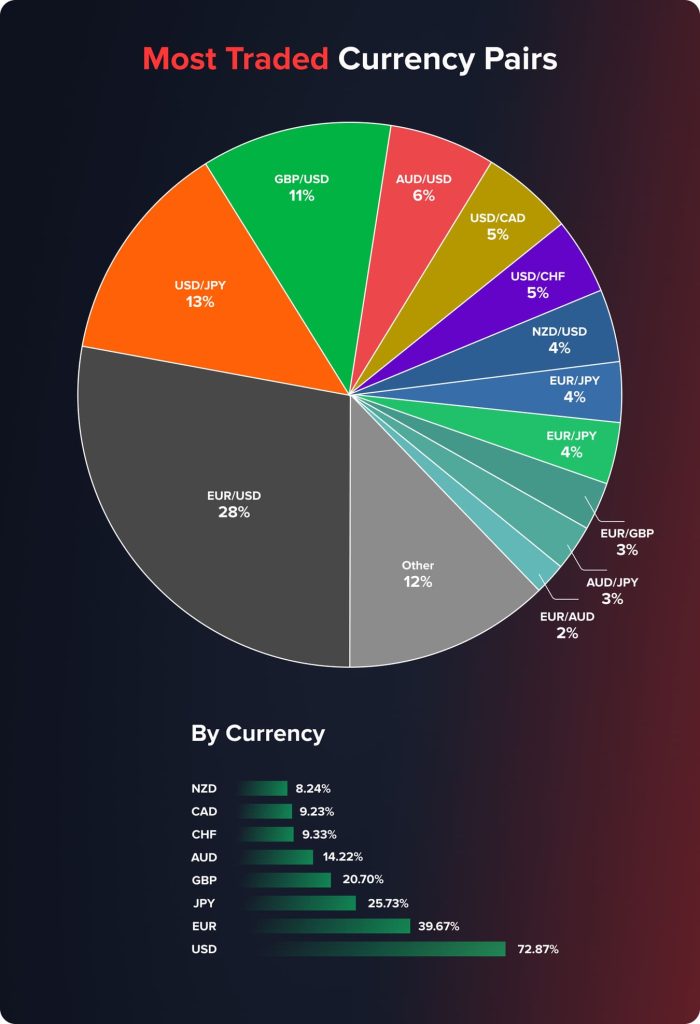
Major currency pairs represent the most liquid and actively traded combinations in the forex market. These seven pairs account for approximately 80% of global forex trading volume and offer the tightest spreads and highest liquidity.
| Currency Pair | Common Name | Market Share | Typical Spread | Best Trading Sessions |
|---|---|---|---|---|
| EUR/USD | Euro Dollar | 28% | 1-2 pips | London, New York |
| USD/JPY | Dollar Yen | 13% | 1-2 pips | Tokyo, London |
| GBP/USD | Cable | 11% | 2-3 pips | London, New York |
| USD/CHF | Swissie | 5% | 2-4 pips | London, New York |
| AUD/USD | Aussie | 7% | 2-3 pips | Sydney, London |
| USD/CAD | Loonie | 5% | 2-4 pips | New York, London |
| NZD/USD | Kiwi | 2% | 3-5 pips | Sydney, London |
EUR/USD - The World's Most Traded Pair
The EUR/USD represents the exchange rate between the Eurozone's Euro and the US Dollar. With 28% of global forex volume, this pair offers excellent liquidity and predictable price movements. It's heavily influenced by economic data from both the European Central Bank and Federal Reserve.
USD/JPY - The Asian Market Leader
USD/JPY is the most traded pair involving Asian currencies. Known for its technical trading opportunities and strong trending behavior, it's particularly active during Asian and early European sessions.
GBP/USD - "Cable" with High Volatility
Named "Cable" after the transatlantic cable connecting London and New York, GBP/USD is known for its volatility and strong price movements. Brexit developments and Bank of England policies significantly impact this pair.
Why Major Pairs Dominate Trading
Major currency pairs maintain their popularity due to several key advantages:
- High Liquidity: Easy entry and exit with minimal slippage
- Tight Spreads: Lower trading costs increase profitability
- Abundant Information: Extensive news coverage and analysis
- Predictable Patterns: Well-established technical and fundamental drivers
3. Minor and Exotic Currency Pairs
Beyond major pairs, the forex market offers numerous opportunities through minor and exotic currency pairs. Understanding these alternatives can diversify your trading portfolio and potentially uncover unique profit opportunities.
Cross Currency Pairs (Minor Pairs)
Cross currency pairs, or simply "crosses," are currency pairs that don't include the US Dollar. These pairs often exhibit different characteristics from major pairs and can provide opportunities when the dollar lacks clear direction.
• EUR/GBP - Euro vs British Pound
• EUR/JPY - Euro vs Japanese Yen
• GBP/JPY - British Pound vs Japanese Yen
• AUD/JPY - Australian Dollar vs Japanese Yen
Cross pairs are calculated using the exchange rates of their component currencies against the US Dollar. For example, EUR/GBP is derived from EUR/USD and GBP/USD rates.
Exotic Currency Pairs
Exotic pairs combine a major currency with an emerging market or smaller economy currency. These pairs offer higher potential returns but come with increased risks and costs.
| Category | Examples | Typical Spread | Liquidity | Volatility |
|---|---|---|---|---|
| Major Pairs | EUR/USD, GBP/USD, USD/JPY | 1-3 pips | Very High | Moderate |
| Minor Pairs | EUR/GBP, AUD/JPY, GBP/CAD | 3-6 pips | High | Moderate-High |
| Exotic Pairs | USD/TRY, EUR/NOK, GBP/ZAR | 10-50 pips | Low-Medium | Very High |
Liquidity Considerations
Liquidity decreases as you move from major to minor to exotic pairs. Lower liquidity results in:
- Wider spreads increasing trading costs
- Potential slippage during order execution
- Less predictable price movements
- Increased sensitivity to economic events
Trading Costs and Spread Differences
Understanding spread differences is crucial for profitable trading. While EUR/USD might have a 1-2 pip spread, exotic pairs like USD/TRY can have spreads exceeding 20 pips. This means you need larger price movements to achieve profitability when trading exotics.
4. Currency Pair Correlations
Currency pair correlations measure how currency pairs move in relation to each other. Understanding these relationships is essential for risk management and can help you avoid overexposing your portfolio to similar market movements.
Positive and Negative Correlations
Correlations range from -1 to +1:
- +1 (Perfect Positive): Pairs move in exactly the same direction
- 0 (No Correlation): Pairs move independently
- -1 (Perfect Negative): Pairs move in exactly opposite directions
• EUR/USD and GBP/USD: +0.85 (Strong Positive)
• EUR/USD and USD/CHF: -0.95 (Strong Negative)
• AUD/USD and NZD/USD: +0.87 (Strong Positive)
How Correlations Affect Portfolio Risk
Trading highly correlated pairs simultaneously can amplify both profits and losses. If you're long EUR/USD and GBP/USD (correlation +0.85), you're essentially taking a similar position twice, doubling your exposure to USD weakness.
Using Correlation for Hedging
Negative correlations can provide natural hedging opportunities. For example, if you're long EUR/USD, you might consider a long position in USD/CHF to hedge against adverse EUR movements, given their strong negative correlation.
Correlation Changes Over Time
Currency correlations aren't static. They change based on:
- Economic events and policy changes
- Market sentiment and risk appetite
- Geopolitical developments
- Commodity price movements (especially for commodity currencies)
5. Choosing the Right Pairs to Trade
Selecting appropriate currency pairs is crucial for trading success. The best currency pairs to trade depend on your experience level, trading style, available time, and risk tolerance.
Best Currency Pairs for Beginners
New traders should focus on major pairs due to their favorable characteristics:
| Pair | Why Good for Beginners | Key Benefits | Watch Out For |
|---|---|---|---|
| EUR/USD | Most liquid, predictable | Tight spreads, abundant analysis | ECB and Fed announcements |
| USD/JPY | Strong trends, technical patterns | Responds well to technical analysis | BOJ intervention levels |
| GBP/USD | High volatility for profit | Strong price movements | High volatility can increase losses |
Matching Pairs to Your Trading Session
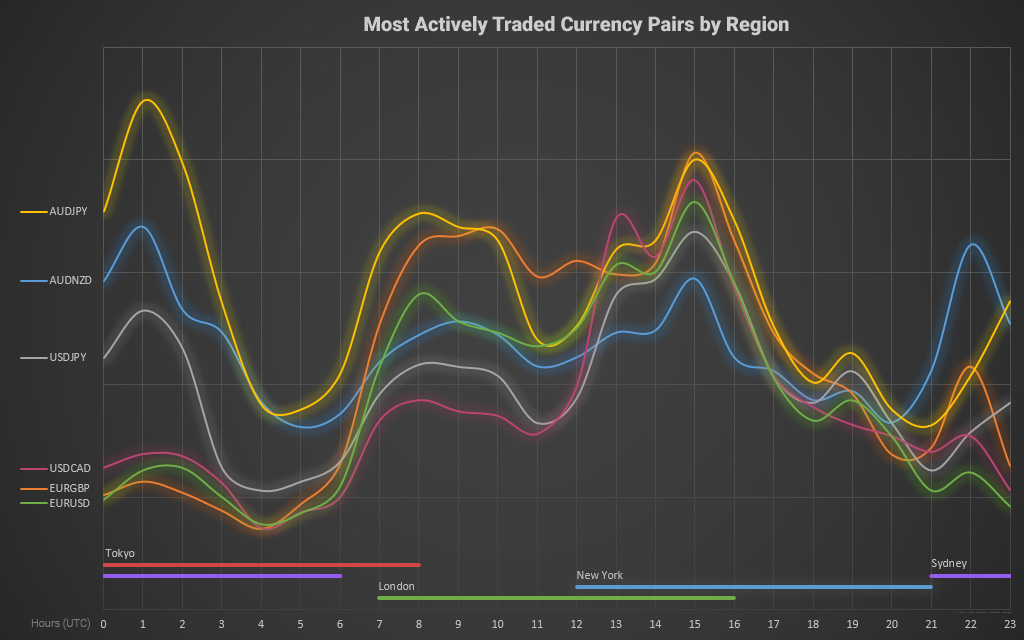
Currency pair activity varies throughout the trading day. Align your pair selection with your available trading hours:
- Asian Session (12:00-09:00 GMT): USD/JPY, AUD/USD, NZD/USD
- London Session (08:00-17:00 GMT): EUR/USD, GBP/USD, EUR/GBP
- New York Session (13:00-22:00 GMT): EUR/USD, GBP/USD, USD/CAD
- Overlap Periods: Maximum liquidity for all major pairs
Volatility Considerations
Different pairs offer varying volatility levels. Choose based on your risk preference:
Medium Volatility (Balanced): USD/JPY, AUD/USD
High Volatility (Higher Risk/Reward): GBP/USD, GBP/JPY
Diversification Strategies
Effective portfolio diversification involves:
- Trading pairs from different correlation groups
- Balancing exposure to different economies
- Mixing trend-following and range-bound strategies
- Adjusting position sizes based on pair volatility
Related Articles to Explore:
Frequently Asked Questions
What are the best currency pairs for beginners to trade?
The best currency pairs for beginners are the major pairs: EUR/USD, USD/JPY, and GBP/USD. These offer tight spreads, high liquidity, and abundant educational resources. Start with EUR/USD as it's the most traded and predictable pair.
How many currency pairs should I trade simultaneously?
Beginners should focus on 2-3 currency pairs maximum. This allows you to learn each pair's characteristics thoroughly without overwhelming yourself. As you gain experience, you can gradually expand to 5-7 pairs.
What's the difference between major and minor currency pairs?
Major pairs include the US Dollar and account for about 80% of forex trading volume. Minor pairs (crosses) don't include the USD but involve other major currencies. Major pairs typically have tighter spreads and higher liquidity than minor pairs.
How do currency pair correlations affect my trading?
Currency correlations determine how pairs move relative to each other. Trading highly correlated pairs simultaneously can double your risk exposure. Understanding correlations helps you diversify effectively and avoid unintended risk concentration.
Should I avoid exotic currency pairs as a beginner?
Yes, beginners should generally avoid exotic pairs. They have wider spreads, lower liquidity, and higher volatility, making them more challenging and expensive to trade. Focus on major pairs until you develop solid trading skills.
When is the best time to trade different currency pairs?
Trade pairs when their respective markets are most active: EUR/USD during London-New York overlap, USD/JPY during Tokyo-London sessions, and AUD/USD during Sydney-London hours. Higher activity means better liquidity and tighter spreads.
Comments
Post a Comment