
Forex vs Stocks Comparison: Which Market Should You Trade?
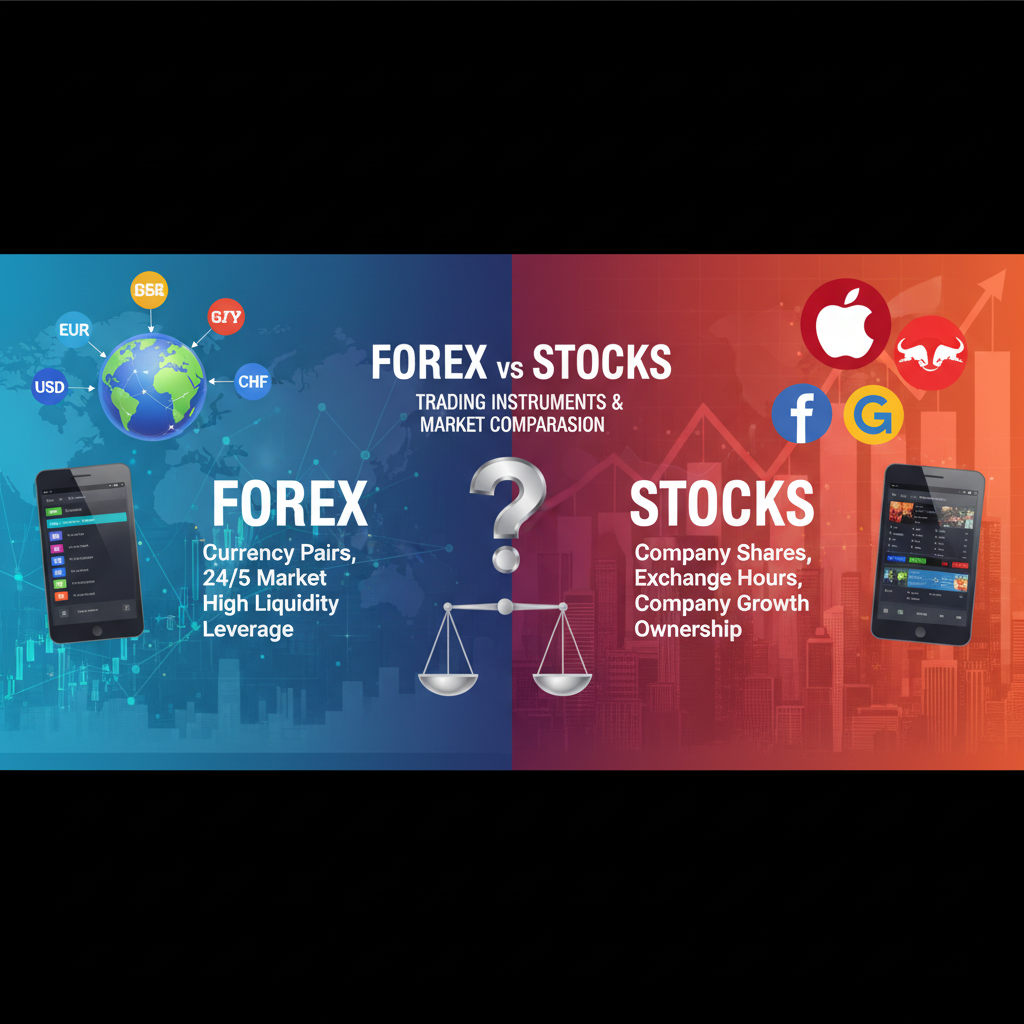
Choosing between forex and stock trading can be intimidating for beginners. Both markets offer unique opportunities, but understanding their differences is essential to make a thoughtful decision that aligns with your goals, risk tolerance, and lifestyle.
Market Overview and Key Differences
Understanding the fundamental differences between forex and stock markets is essential before diving into either. These two financial markets operate differently in terms of size, accessibility, and structure.
Market Size and Volume
The forex market dwarfs the stock market in terms of daily trading volume. With approximately $6.6 trillion traded daily, the forex market is the largest and most liquid financial market in the world. In contrast, the global stock market sees around $200 billion in daily trading volume. This massive difference in liquidity means that forex trades can be executed almost instantaneously without significant price slippage, especially for major currency pairs.
Trading Hours and Accessibility
One of the most significant differences between forex vs stocks lies in their trading schedules. The forex market operates 24 hours a day, 5 days a week, opening Sunday evening in Asia and closing Friday evening in New York. This continuous operation is possible because currencies are traded across different time zones worldwide.
Stock markets, however, have limited trading hours that depend on the specific exchange. For example, the New York Stock Exchange (NYSE) operates from 9:30 AM to 4:00 PM EST, Monday through Friday. While some brokers offer extended hours trading, the core market activity is confined to these periods.
Number of Trading Instruments
The forex market focuses on currency pairs, with most traders concentrating on the major pairs like EUR/USD, GBP/USD, and USD/JPY. In total, there are around 50+ actively traded currency pairs, making it relatively easy to specialize and develop expertise.
The stock market offers thousands of individual stocks to choose from. In the US alone, there are over 4,000 publicly traded companies on major exchanges. This vast selection can be overwhelming for beginners but also provides more opportunities for diversification and sector-specific investments.
Market Participants and Structure
The forex market is decentralized, meaning there's no central exchange. Trading occurs through an interbank network of banks, financial institutions, and electronic communication networks (ECNs). Major participants include central banks, commercial banks, hedge funds, and retail traders.
Stock markets operate through centralized exchanges like the NYSE, NASDAQ, and LSE. Market makers, institutional investors, mutual funds, pension funds, and individual investors all participate in price discovery and liquidity provision.
Trading Characteristics Comparison
Volatility and Price Movements
Forex and stock markets exhibit different volatility patterns. Currency pairs typically show moderate daily volatility, with major pairs like EUR/USD moving 50-100 pips on average per day. However, during major economic events or geopolitical tensions, volatility can spike dramatically.
Individual stocks can be much more volatile, especially smaller-cap companies or those in emerging industries. A single earnings report or company announcement can cause stock prices to move 10-20% or more in a single day. Blue-chip stocks tend to be more stable but can still experience significant movements during market-wide events.
Leverage Availability
Forex trading typically offers higher leverage than stock trading. Retail forex brokers commonly provide leverage ratios of 30:1 to 100:1 (or even higher in some jurisdictions). This means you can control a $100,000 position with just $1,000 to $3,333 in margin.
Stock trading leverage is generally more conservative. In the US, the typical margin requirement is 50%, effectively providing 2:1 leverage. Some brokers offer up to 4:1 leverage for day trading, but this is still significantly lower than forex leverage.
Transaction Costs Structure
The cost structure differs significantly between these markets. Forex brokers typically earn money through spreads - the difference between the bid and ask prices. Major currency pairs often have very tight spreads, sometimes as low as 0.1-0.3 pips with professional brokers.
Stock trading involves commissions charged per trade or per share. While many brokers now offer commission-free stock trading, this is often limited to US stocks and may come with wider spreads or payment for order flow arrangements.
Execution Speed and Market Depth
Due to the forex market's massive liquidity, trade execution is typically very fast, often occurring within milliseconds. The deep market depth means that even large orders can be filled without significant price impact.
Stock execution speed varies depending on the stock's liquidity and market conditions. Popular large-cap stocks usually have good liquidity, but smaller stocks may experience slower fills and wider bid-ask spreads.
Short Selling Ease
In forex trading, short selling is built into the structure. When you sell EUR/USD, you're simultaneously shorting the euro and going long the dollar. There are no uptick rules or hard-to-borrow fees.
Stock short selling can be more complex, with requirements to locate shares to borrow, potential hard-to-borrow fees, and regulations like the uptick rule that can limit when you can short sell certain stocks.
Pros and Cons: Forex Trading
Advantages of Forex Trading
24-Hour Market Access
The forex market never sleeps during weekdays, allowing you to trade around your schedule. Whether you're a night owl or early bird, you can find active trading sessions that suit your lifestyle. This flexibility is particularly beneficial for those with full-time jobs who want to trade part-time.
High Liquidity
The massive daily volume ensures that you can enter and exit positions quickly without worrying about getting stuck in a trade. This liquidity also means tighter spreads and reduced slippage, especially for major currency pairs.
Lower Capital Requirements
Thanks to high leverage, you can start forex trading with relatively small amounts of capital. Some brokers allow you to open accounts with as little as $100-$500, though adequate risk management requires more substantial funding.
Focused Market Analysis
With only 8 major currency pairs accounting for most of the trading volume, you can focus your analysis and become an expert on specific currencies and their driving factors.
Disadvantages of Forex Trading
High Leverage Risk
While leverage can amplify profits, it equally amplifies losses. New traders often underestimate the risk and can lose their entire account quickly with poor risk management.
No Ownership Rights
Unlike stocks, forex trading doesn't give you ownership in any company or asset. You're purely speculating on price movements without receiving dividends or voting rights.
Complex Fundamental Analysis
Currency values are influenced by complex macroeconomic factors including interest rates, political stability, economic data, and central bank policies. Understanding these relationships requires significant study and experience.
Regulatory Concerns
The forex market's decentralized nature can lead to less regulatory oversight in some jurisdictions, potentially exposing traders to broker fraud or manipulation.
Best Suited For
Forex trading is ideal for those who prefer short to medium-term trading strategies, enjoy analyzing macroeconomic trends, have good risk management discipline, and want the flexibility to trade at various times of day.
Pros and Cons: Stock Trading
Advantages of Stock Trading
Ownership and Dividends
When you buy stocks, you become a partial owner of the company. This ownership can provide dividend income and potential voting rights in corporate decisions. Quality dividend-paying stocks can provide passive income while you hold them.
Long-term Wealth Building
Historically, the stock market has provided strong long-term returns. The S&P 500 has averaged approximately 10% annual returns over the past century, making it an excellent vehicle for long-term wealth building and retirement planning.
Fundamental Analysis Opportunities
Company financial statements, business models, and industry analysis provide concrete data for making investment decisions. Many investors find analyzing companies more intuitive than analyzing entire economies.
Regulatory Protection
Major stock exchanges are heavily regulated, providing investor protections like SIPC insurance in the US, which protects against broker failures up to $500,000 per account.
Diverse Investment Options
The stock market offers exposure to every industry and sector imaginable, from technology and healthcare to utilities and consumer goods. This diversity allows for strategic sector rotation and risk diversification.
Disadvantages of Stock Trading
Limited Trading Hours
Most stock trading is confined to exchange hours, typically 9:30 AM to 4:00 PM EST for US markets. This limitation can be problematic if you have a full-time job during these hours or if news breaks after hours.
Higher Capital Requirements
Without the high leverage available in forex, stock trading typically requires more capital to generate meaningful returns. The Pattern Day Trader rule in the US requires a minimum of $25,000 for active day trading.
Company-Specific Risks
Individual stocks can become worthless if companies fail, declare bankruptcy, or face severe business problems. This idiosyncratic risk requires careful research and diversification.
Lower Leverage Options
The limited leverage in stock trading means smaller position sizes relative to your capital, which can limit profit potential compared to forex trading.
Best Suited For
Stock trading works well for long-term investors, those who enjoy researching companies and industries, investors seeking dividend income, and those who prefer the stability of regulated exchanges.
Making Your Choice: Forex or Stocks?
Consider Your Personality and Lifestyle
Your choice between forex vs stocks should align with your personality and lifestyle. Are you someone who thrives on fast-paced action and can handle the psychological pressure of leveraged trading? Forex might suit you. Do you prefer thorough research, patient analysis, and long-term wealth building? Stocks could be your better option.
Time Commitment Assessment
Consider how much time you can dedicate to trading and market analysis. Forex trading, especially short-term strategies, often requires constant market monitoring and quick decision-making. Stock investing can be more passive, with some strategies requiring only periodic portfolio reviews.
Capital Requirements
Evaluate your available capital honestly. While you can start forex trading with smaller amounts due to leverage, you need sufficient capital to withstand normal market fluctuations. For stocks, especially if you want to diversify across multiple companies, you'll need more substantial initial capital.
Learning Curve Considerations
Both markets require education, but they focus on different skill sets. Forex demands understanding of macroeconomic principles, central bank policies, and global political events. Stock trading requires skills in financial statement analysis, industry research, and company valuation.
Risk Tolerance
Honestly assess your risk tolerance. The high leverage in forex can lead to rapid account growth but equally rapid losses. Stock trading, while still risky, typically offers more controlled risk levels, especially for diversified portfolios.
Combining Both Markets
Many successful traders don't limit themselves to just one market. You might consider allocating a portion of your capital to long-term stock investments for steady growth while using another portion for shorter-term forex trading. This hybrid approach can provide both stability and growth potential.
Getting Started Recommendations
Regardless of which market you choose, start with education and practice. Open demo accounts in both forex and stock trading to get hands-on experience without risking real money. Read reputable trading books, take courses, and consider finding a mentor who's successful in your chosen market.
Begin with small position sizes when you start trading with real money. Focus on learning proper risk management before trying to maximize profits. Remember that consistency and preservation of capital are more important than hitting home runs early in your trading career.
Forex vs. Stocks: Quick Comparison Table
| Factor | Forex Market | Stock Market |
|---|---|---|
| Daily Trading Volume | $6.6 trillion | $200 billion |
| Trading Hours | 24 hours, 5 days a week | Limited exchange hours |
| Number of Instruments | 50+ currency pairs | Thousands of stocks |
| Typical Leverage | 30:1 to 100:1 | 2:1 to 4:1 |
| Minimum Capital | $100-$500 | $1,000-$25,000 |
| Transaction Costs | Spreads (0.1-3 pips) | Commissions (often $0) |
| Ownership Rights | None | Company shares & dividends |
| Short Selling | Built-in, no restrictions | Borrowing required, some restrictions |
| Market Structure | Decentralized (OTC) | Centralized exchanges |
| Ideal For | Short-term traders, part-time trading | Long-term investors, fundamental analysis |
Frequently Asked Questions
Which is easier for beginners: forex or stocks?
Stock trading is generally considered easier for beginners because it involves analyzing companies rather than complex macroeconomic factors. The lower leverage also means mistakes are less costly. However, the "easier" market depends on your interests and learning style.
Can you make more money in forex or stocks?
Both markets offer profit potential, but they work differently. Forex's high leverage can generate quick profits but also quick losses. Stocks have historically provided consistent long-term returns averaging around 10% annually. Your success depends more on your skills and strategy than the market choice.
How much money do you need to start trading forex vs stocks?
You can start forex trading with $100-$500 due to high leverage, though $1,000-$5,000 is recommended for proper risk management. Stock trading typically requires $1,000-$25,000, especially if you want to day trade or diversify across multiple stocks.
Which market is more volatile: forex or stocks?
Individual stocks can be more volatile than major currency pairs, especially small-cap stocks or those affected by company-specific news. However, forex volatility can spike during major economic events or geopolitical tensions. Major currency pairs typically show moderate daily volatility.
Should I trade forex or stocks as a part-time trader?
Forex is often better for part-time traders because of its 24-hour availability. You can trade before work, during lunch breaks, or in the evening. Stock markets' limited hours can be challenging if you work a traditional 9-5 job, though some after-hours trading is available.
Is forex trading gambling?
Forex trading is not gambling when approached with proper education, strategy, and risk management. However, it can become gambling-like if you trade without a plan, use excessive leverage, or make emotional decisions. The same applies to stock trading.
Comments
Post a Comment