
Forex Brokers Guide: How to Choose the Best Broker in 2025
Choosing the right forex broker can mean the difference between trading success and financial disasters. With thousands of brokers competing for your business and endless horror stories from deceived traders who lost their hard-earned money, making a thoughtful decision has become more important than ever. In 2025, the forex brokerage landscape continues to evolve with stricter regulations, advanced trading platforms, and increasingly competitive pricing structures.

This comprehensive guide will walk you through everything you need to know about selecting the best forex broker for your trading needs. Whether you're a complete beginner taking your first steps in currency trading or an intermediate trader looking to switch brokers, understanding the key selection criteria will protect your capital and optimize your trading experience.
1. Why Choosing the Right Broker Matters
Your forex broker is more than just a gateway to the currency markets—they're your trading partner, and their quality directly impacts your profitability, security, and overall trading experience. Here's why this decision is so crucial:
Impact on Trading Costs
Trading costs can significantly erode your profits over time. The difference between a broker charging 2-pip spreads versus 0.5-pip spreads on EUR/USD might seem minor, but for active traders executing dozens of trades per week, this translates to thousands of dollars annually. According to industry data, trading costs—including spreads, commissions, and overnight fees—can account for 30-50% of a retail trader's total expenses.
Consider this example: If you trade 10 standard lots per day (1 million units) with a 2-pip spread, you're paying $200 daily in spreads alone. That's $4,000 per month or $48,000 annually. A broker offering 0.5-pip spreads would reduce this to $12,000 yearly—a savings of $36,000. This stark difference underscores why comparing trading costs is non-negotiable.
Security and Fund Protection
The forex market sees its fair share of scams and fraudulent brokers. In 2024 alone, regulatory bodies like the FCA and CFTC issued hundreds of warnings against unlicensed brokers promising guaranteed returns and engaging in deceptive practices. Choosing a regulated broker ensures your funds are protected through segregated client accounts, negative balance protection, and investor compensation schemes.
Regulated brokers must maintain minimum capital requirements, undergo regular audits, and comply with strict operational standards. For instance, brokers regulated by the FCA in the UK must participate in the Financial Services Compensation Scheme (FSCS), which protects client funds up to 85,000 in case of broker insolvency. This regulatory safety net is invaluable and simply doesn't exist with unregulated offshore brokers.
Platform Quality and Execution Speed
In forex trading, milliseconds matter. Poor execution speed can result in slippage—the difference between your expected price and the actual execution price. During high-volatility events like major economic announcements, slippage with an inferior broker can cost you significantly. Quality brokers invest in robust infrastructure, multiple server locations, and direct connections to liquidity providers to ensure fast, reliable order execution.
Platform stability is equally important. Imagine being unable to close a losing position because your trading platform crashes during market volatility. Reputable brokers provide stable, well-tested platforms with 99.9%+ uptime and redundancy measures to prevent such disasters.
Red Flags and Brokers to Avoid
According to ForexBrokers.com's 2025 scam broker analysis, there are clear warning signs that should make you run in the opposite direction:
- Unrealistic profit guarantees: Any broker promising "guaranteed returns," "98% win rates," or "risk-free trading" is lying. Forex trading inherently involves risk, and no legitimate broker can guarantee profits.
- Lack of regulation: Brokers operating without licenses from recognized regulatory bodies (FCA, ASIC, CySEC, NFA) pose extreme risk. Without regulatory oversight, your funds have minimal protection.
- Withdrawal difficulties: Numerous complaints about delayed or denied withdrawals are the biggest red flag. Scam brokers often make it easy to deposit but nearly impossible to withdraw.
- High-pressure sales tactics: Legitimate brokers don't use aggressive sales tactics or pressure you to deposit large sums immediately. "Account managers" pushing you to invest more money are a major warning sign.
- Hidden fees and manipulated pricing: Watch for brokers with non-transparent fee structures or whose prices don't match the broader market—they may be manipulating quotes to your disadvantage.
The FCA's warning list and CFTC's RED List contain hundreds of known scam operations. Always verify a broker's regulatory status before depositing funds.
2. Essential Broker Selection Criteria
When evaluating forex brokers, several core criteria should guide your decision. These factors separate reliable, professional brokers from those you should avoid.
Regulation and Licensing
Regulatory oversight is your first line of defense against fraud and malpractice. In 2025, the most respected regulatory bodies include:
Tier-1 Regulators (Strictest Oversight)
- FCA (Financial Conduct Authority - UK): One of the world's most stringent regulators, the FCA requires brokers to maintain significant capital reserves, segregate client funds, and participate in compensation schemes. FCA-regulated brokers undergo rigorous audits and face severe penalties for violations.
- ASIC (Australian Securities and Investments Commission): Known for strict compliance requirements and strong consumer protection measures, ASIC regulates some of the world's most reputable brokers.
- NFA/CFTC (USA): U.S. forex regulation is among the strictest globally. The National Futures Association (NFA) and Commodity Futures Trading Commission (CFTC) enforce strict leverage limits (50:1 for major pairs, 20:1 for minors), mandatory margin calls, and comprehensive reporting requirements. However, fewer brokers operate in the U.S. market due to these stringent requirements.
Tier-2 Regulators (Solid Protection)
- CySEC (Cyprus Securities and Exchange Commission): Regulates many European brokers under MiFID II (Markets in Financial Instruments Directive), providing good client protection within the EU framework.
- BaFin (Germany), AFM (Netherlands), FSA (Japan): National regulators with strong oversight and consumer protection measures.
Pro Tip: Verify a broker's regulatory status directly on the regulator's website, not just on the broker's site. Scam brokers frequently fabricate regulatory credentials. The FCA's Financial Services Register and NFA's BASIC search tool allow you to confirm licensing in minutes.
Trading Costs: Spreads, Commissions, and Overnight Fees
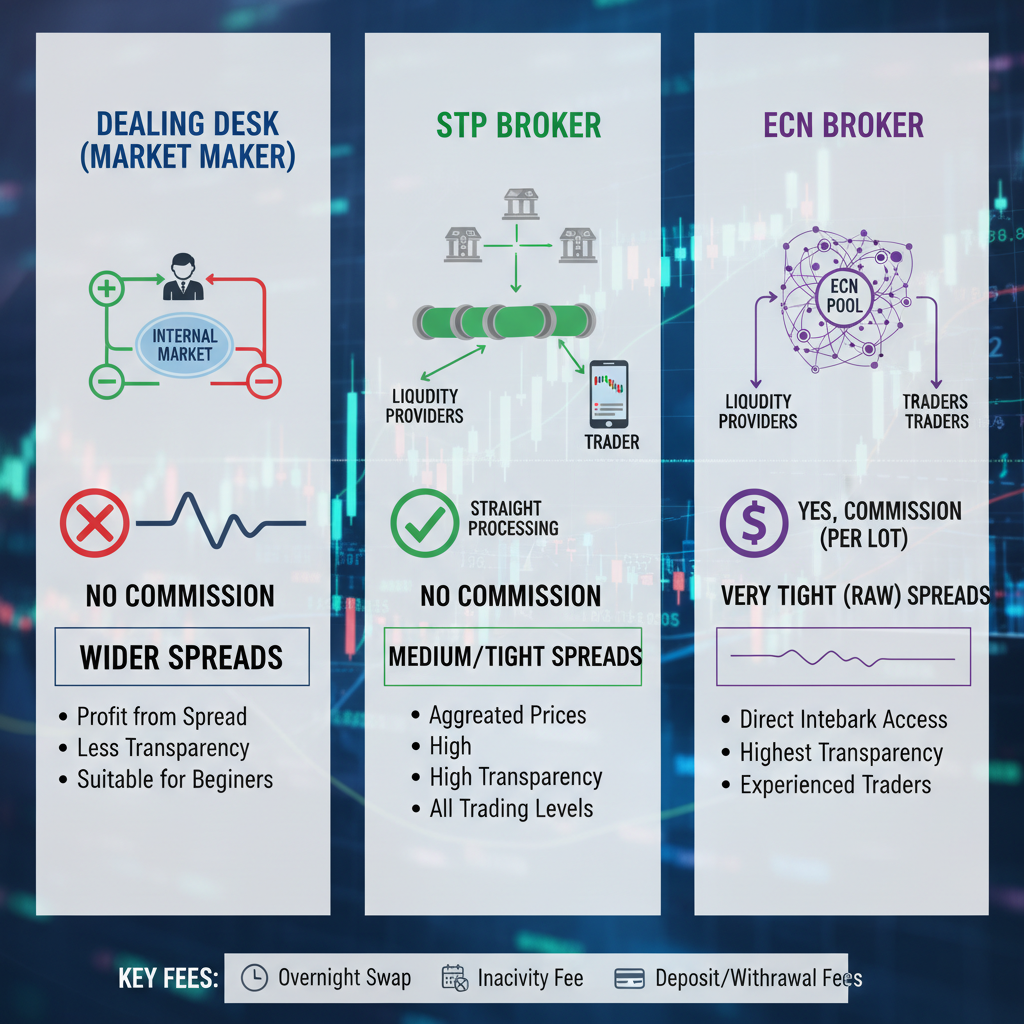
Understanding your broker's fee structure is essential to calculate the true cost of your trading. Brokers earn primarily through three mechanisms:
Spreads
The spread—the difference between the bid (sell) and ask (buy) price—is the most common cost. Spreads come in two varieties:
- Fixed Spreads: Remain constant regardless of market conditions. For example, EUR/USD might always have a 2-pip spread. Fixed spreads provide cost certainty and can prevent widening during volatile market conditions, but they're typically higher than variable spreads during calm markets.
- Variable Spreads: Fluctuate based on market liquidity and volatility. During normal conditions, you might see 0.5-1 pip spreads on EUR/USD, but during major news events or low-liquidity periods (like the Asian session), spreads can widen to 3-5 pips or more. Variable spreads generally offer lower costs during favorable conditions but require awareness of when widening might occur.
Major currency pairs (EUR/USD, GBP/USD, USD/JPY) typically have the tightest spreads, while exotic pairs (USD/TRY, EUR/ZAR) carry significantly wider spreads due to lower liquidity.
Commissions
Some brokers, particularly those offering ECN (Electronic Communication Network) or STP (Straight-Through Processing) accounts, charge a direct commission per trade instead of or in addition to spreads. Typical commission structures range from $2-$7 per lot (per side, so $4-$14 round trip for a 100,000-unit trade).
Commission-based accounts often provide access to tighter raw spreads (starting from 0.0 pips), which can benefit high-volume traders even after factoring in commission costs. Calculate your total cost (spread + commission) to determine which model works best for your trading volume.
Overnight Fees (Swap Rates)
When you hold positions overnight, brokers charge or credit swap fees based on the interest rate differential between the two currencies in your pair. These rollover fees can significantly impact swing traders and position traders who hold trades for days or weeks.
Some brokers offer swap-free (Islamic) accounts that comply with Sharia law by eliminating interest charges, though they may implement other fee structures to compensate.
Leverage and Margin Requirements
Leverage allows you to control large positions with relatively small capital, but it's a double-edged sword that amplifies both profits and losses. Regulatory bodies worldwide have implemented leverage restrictions to protect retail traders:
- United States: Maximum 50:1 on major pairs, 20:1 on minors (NFA/CFTC rules)
- Europe: Maximum 30:1 on major pairs, 20:1 on non-major pairs, 10:1 on commodities (ESMA regulations)
- Australia: ASIC reduced maximum leverage to 30:1 for major pairs in recent years
- Offshore/Unregulated: Some offshore brokers offer 500:1, 1000:1, or even higher leverage—extremely risky and often a red flag
While experienced traders might seek higher leverage for capital efficiency, beginners should approach leverage cautiously. Trading with 100:1 leverage means a 1% adverse move wipes out your entire position. Understanding margin requirements and maintaining adequate account equity is crucial for risk management.
Account Types
Reputable brokers typically offer multiple account types to suit different trader profiles:
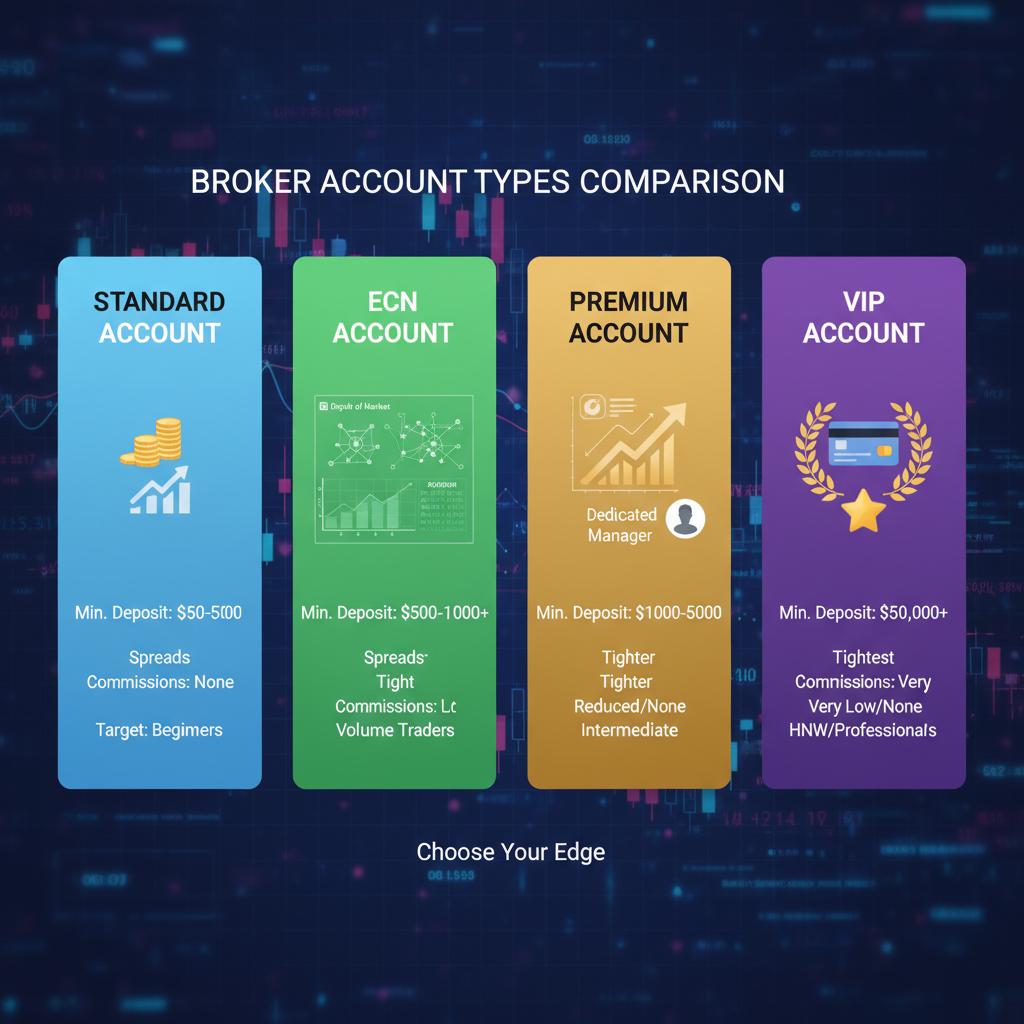
- Micro Accounts: Allow trading in micro lots (1,000 units), ideal for beginners practicing with small capital. Some brokers allow deposits as low as $10-$50 for micro accounts.
- Standard Accounts: Designed for retail traders, typically requiring $100-$1,000 minimum deposits and offering standard lot sizes (100,000 units).
- ECN/Pro Accounts: Provide direct market access with raw spreads plus commission structure. Usually require higher minimum deposits ($1,000-$10,000) but offer superior pricing for active traders.
- VIP/Institutional Accounts: Tailored for high-volume traders with significant capital, offering the tightest spreads, dedicated account managers, and premium services.
Deposit and Withdrawal Methods
Convenient, fast, and affordable funding options are essential. Top brokers support multiple methods:
- Bank wire transfers: Widely accepted but can take 2-5 business days and may incur fees ($15-$50)
- Credit/debit cards: Instant deposits, withdrawals typically take 3-5 business days
- E-wallets: PayPal, Skrill, Neteller offer fast deposits and withdrawals (often within 24 hours), though some brokers charge processing fees
- Cryptocurrency: Growing in popularity, offering near-instant, low-cost transfers, though not all brokers support crypto funding
Pay attention to withdrawal policies—reputable brokers process withdrawals within 1-3 business days. Delays, excessive verification requirements, or withdrawal fees are warning signs. Some brokers impose minimum withdrawal amounts or limit free withdrawals per month.
3. Trading Platform Evaluation
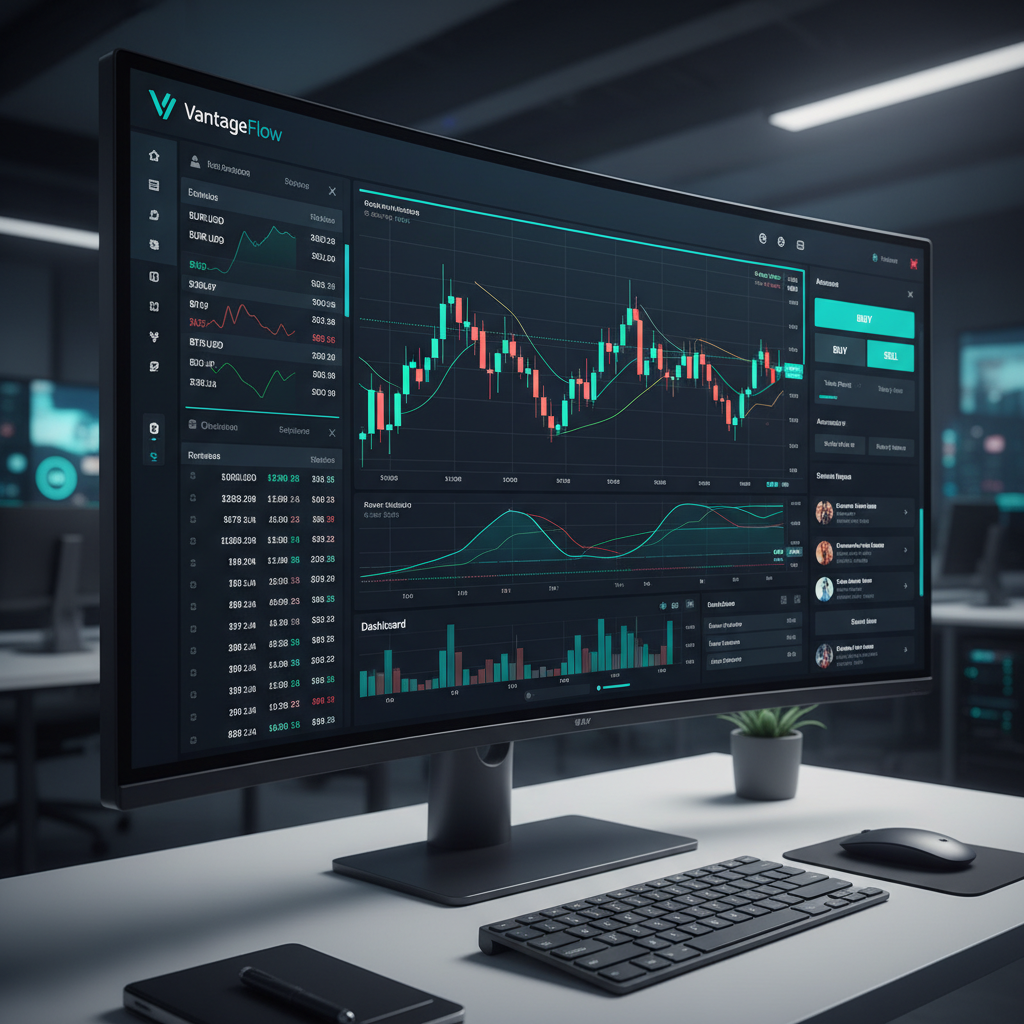
The trading platform is your window to the forex market, making platform quality a crucial factor in selection. In 2025, most brokers offer one or more of the following platforms:
MetaTrader 4 vs. MetaTrader 5: The Industry Standards
MetaTrader platforms, developed by MetaQuotes Software, dominate the retail forex market. Understanding the differences between MT4 and MT5 helps you choose the right platform for your needs.
MetaTrader 4 (MT4)
Launched in 2005, MT4 remains the world's most popular forex trading platform despite its age. Its strengths include:
- User-friendly interface: Clean, intuitive design perfect for beginners while offering sufficient tools for experienced traders
- Extensive ecosystem: Thousands of custom indicators, Expert Advisors (EAs) for automated trading, and third-party tools available
- 30 built-in technical indicators: Covers all essential technical analysis needs
- 9 timeframes: From 1-minute to 1-month charts
- Familiar to millions: Widespread adoption means abundant tutorials, forums, and community support
- Lower system requirements: Runs smoothly on modest hardware
Limitations: MT4 is forex-focused and doesn't natively support stocks, futures, or exchange-traded instruments. MetaQuotes officially stopped licensing MT4 to new brokers in 2025, though existing brokers can continue offering it. The platform uses 32-bit architecture and single-threaded backtesting, limiting performance with modern systems.
MetaTrader 5 (MT5)
Released in 2010 as MT4's successor, MT5 offers significant improvements and additional capabilities:
- Multi-asset support: Trade forex, stocks, commodities, futures, and CFDs from a single platform
- 38 built-in indicators: More comprehensive technical analysis tools
- 21 timeframes: Including M2, M3, H3 for granular analysis
- Advanced order types: Fill or Kill, Immediate or Cancel, partial fill logic
- Integrated economic calendar: Real-time economic events and forecasts within the platform
- Depth of Market (DOM): View multiple liquidity layers for better price transparency
- Both hedging and netting: Flexibility in position management (MT4 only supports hedging)
- MQL5 programming: Object-oriented language (similar to C++) enabling faster, more sophisticated automated strategies
- Multi-threaded backtesting: Test strategies across multiple currency pairs simultaneously with real tick data
- 64-bit architecture: Better performance and resource utilization
Trade-offs: MT5's added complexity creates a steeper learning curve for beginners. The MT5 ecosystem, while growing, still lags behind MT4's massive library of custom tools and indicators. The platform requires more powerful hardware for optimal performance.
Which Should You Choose?
For pure forex trading with a focus on simplicity and maximum third-party tool availability, MT4 remains an excellent choice. However, if you plan to trade multiple asset classes, need advanced analysis tools, or want a future-proof platform with active development, MT5 is superior. Many traders use both platforms for different purposes.
Proprietary Platforms
Some brokers develop their own trading platforms, offering unique features and interfaces. Examples include cTrader (popular for its superior charting and ECN trading), FOREX.com's proprietary platform, and IG's advanced web and mobile platforms. Proprietary platforms can offer advantages like:
- Superior mobile trading experiences optimized for touch interfaces
- Advanced features like automated technical pattern recognition
- Deeper integration with the broker's research, analysis, and educational content
- Modern, intuitive interfaces leveraging current design principles
However, proprietary platforms lack the portability of MT4/MT5—switching brokers means learning a new platform entirely and rebuilding any automated strategies from scratch.
Mobile Trading Capabilities
With increasing numbers of traders managing positions on-the-go, mobile platform quality is crucial. Evaluate mobile apps for:
- Full functionality: Can you execute all order types, access full charting capabilities, and modify positions as easily as on desktop?
- Reliability: Does the app maintain stable connections and execute orders reliably during high volatility?
- Notifications: Real-time price alerts, margin call warnings, and order execution confirmations keep you informed
- Biometric security: Fingerprint or face recognition for quick, secure login
- Responsiveness: Smooth, fast performance without lag or crashes
Charting Tools and Indicators
Technical traders rely heavily on charting capabilities. Essential features include:
- Multiple chart types (candlesticks, bars, line, Heikin Ashi, Renko)
- Drawing tools (trendlines, Fibonacci retracements, channels, rectangles)
- Comprehensive indicator library with customization options
- Ability to save chart templates and workspace layouts
- Multi-chart viewing for analyzing multiple pairs simultaneously
- Customizable colors, fonts, and visual elements
Order Execution Types
Understanding how your broker executes orders impacts the quality of your fills:
- Market Execution: Orders filled at the best available market price (may experience slippage during volatility)
- Instant Execution: Broker quotes a specific price; you accept or reject it (if the price moves, you receive a requote)
- Pending Orders: Buy Stop, Sell Stop, Buy Limit, Sell Limit orders triggered when price reaches specified levels
- Stop Loss & Take Profit: Automatic closing orders to limit losses and secure profits
- Trailing Stops: Dynamic stop losses that move with price to protect profits
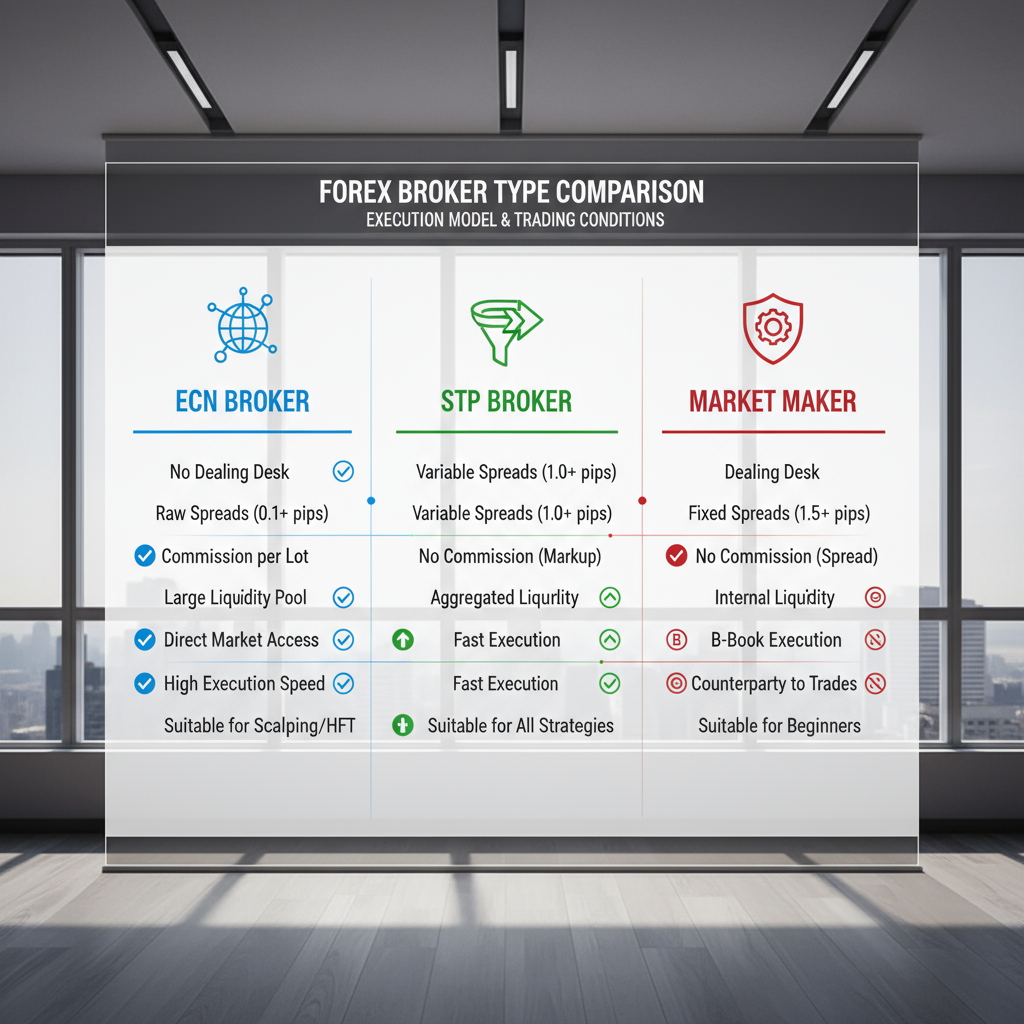
ECN/STP brokers typically offer superior execution with minimal slippage by routing orders directly to liquidity providers rather than acting as the counterparty to your trades.
4. Additional Features to Consider
Beyond the fundamentals, several value-added features distinguish excellent brokers from merely adequate ones.
Demo Account Quality
Every trader should test a broker's platform and services with a demo account before risking real capital. Quality demo accounts offer:
- Realistic market conditions: Demo pricing and execution should mirror live accounts, not artificially favorable conditions
- Adequate virtual funds: Typically $10,000-$100,000 to properly test strategies
- Unlimited or extended duration: Avoid brokers limiting demos to 7-14 days; serious testing requires more time
- Full platform access: No feature restrictions compared to live accounts
- Easy renewal: Ability to reset or open new demos without hassle
Be aware that demo account psychology differs significantly from live trading—there's no emotional impact when virtual money is at stake. Still, demos are invaluable for learning platform functionality and testing strategies.
Educational Resources
Top-tier brokers invest in comprehensive educational content to help traders succeed:
- Structured learning paths: Organized courses from beginner to advanced topics
- Webinars and live workshops: Interactive sessions with professional traders
- Video tutorials: Platform guides, strategy explanations, and market analysis
- Trading guides and e-books: Written resources covering technical analysis, fundamental analysis, risk management, and trading psychology
- Glossary and FAQs: Quick reference for terminology and common questions
While educational resources shouldn't be your primary selection criterion, they provide significant value for developing traders and demonstrate the broker's commitment to client success.
Customer Support (24/7 Availability)
Forex markets trade 24/5, and problems don't wait for business hours. Reliable technical support is essential:
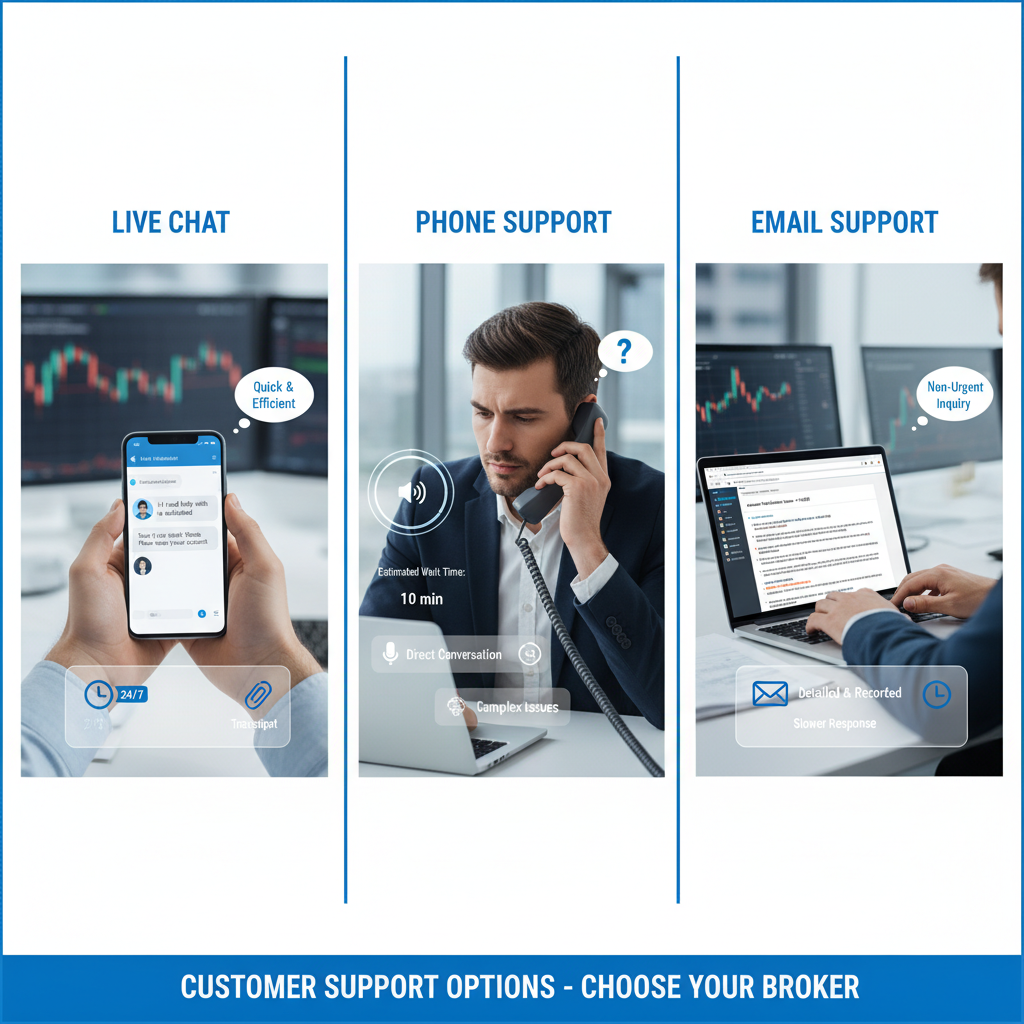
- 24/5 or 24/7 availability: Support during all market hours (some brokers offer weekend support for account issues)
- Multiple contact channels: Live chat, phone, email, and support tickets
- Multilingual support: Service in your native language
- Knowledgeable representatives: Staff who understand trading concepts and can solve technical issues
- Fast response times: Live chat responses within minutes, email responses within hours
Test customer support before opening an account: Contact them with questions about account types, fees, or platform features. Their responsiveness and knowledge level will preview what you can expect as a client.
Research and Analysis Tools
Professional-grade brokers provide market analysis and research to support informed trading decisions:
- Daily market analysis: Professional commentary on major currency movements and upcoming events
- Economic calendars: Schedule of data releases with forecasts and historical data
- Trading signals: Some brokers provide trade ideas (though these should never replace your own analysis)
- Sentiment indicators: Client positioning data showing what percentage of traders are long or short on major pairs
- Technical analysis reports: Chart-based analysis identifying key support, resistance, and patterns
- News feeds: Real-time financial news from providers like Reuters, Bloomberg, or Dow Jones
Social Trading and Copy Trading Options
Social trading platforms allow you to follow, learn from, and automatically copy the trades of successful traders:
- Copy Trading: Allocate a portion of your account to automatically replicate another trader's positions
- Performance Statistics: Detailed track records showing copier's historical performance, win rate, average risk, and more
- Social Features: Forums, chat, and community interaction to discuss strategies
- Risk Controls: Set maximum position sizes, stop-loss limits, and capital allocation to manage risk when copying
Popular social trading platforms include eToro, ZuluTrade, and Myfxbook AutoTrade. While copy trading can help beginners learn, remember that past performance doesn't guarantee future results, and you still bear full responsibility for your account.
5. Broker Comparison Checklist
Use this systematic approach to evaluate and compare brokers effectively:
Step-by-Step Evaluation Process
Step 1: Verify Regulatory Status
- Identify the broker's claimed regulatory jurisdictions
- Visit regulatory websites directly (FCA Register, NFA BASIC, ASIC Connect) to confirm licensing
- Check regulatory warning lists for any red flags
- Verify the regulatory license number matches the broker's claims
Step 2: Compare Trading Costs
- Request detailed pricing information for your most-traded currency pairs
- Calculate total cost including spreads, commissions, and potential swap fees
- Consider your trading volume—high-frequency traders benefit more from tight spreads
- Check for hidden fees (inactivity fees, withdrawal fees, account maintenance fees)
Step 3: Evaluate Platform and Tools
- Open a demo account to test the trading platform firsthand
- Assess ease of use, stability, and feature set
- Test mobile apps on your device
- Verify availability of technical indicators and charting tools you use
Step 4: Test Customer Support
- Contact support via different channels (live chat, email, phone)
- Measure response times and quality of answers
- Ask technical questions to gauge representative knowledge
- Test support during different times (including nights and weekends if claiming 24/7 service)
Step 5: Review Account Types and Requirements
- Confirm minimum deposit requirements fit your budget
- Understand leverage limitations based on your jurisdiction
- Review available account currencies
- Check funding and withdrawal methods available in your country
Questions to Ask Before Opening an Account
Before committing to a broker, get clear answers to these critical questions:
- What is your regulatory license number, and who regulates you? Verify this independently.
- How are client funds protected? Look for segregated accounts and compensation schemes.
- What is your exact fee structure? Get specifics on spreads, commissions, overnight fees, and any other charges.
- What is your average execution speed? Fast execution (under 100ms) minimizes slippage.
- Do you act as a market maker or route orders to liquidity providers? ECN/STP models typically offer better execution.
- What is your withdrawal process and timeline? Understand how long withdrawals take and what verification is required.
- Are there any withdrawal fees or limits? Some brokers charge for withdrawals or limit frequency.
- What happens if my account goes negative? Negative balance protection is crucial, especially with high leverage.
- What customer support is available, and in what languages? Ensure support during your trading hours.
- Are there any account inactivity fees? Some brokers charge monthly fees if you don't trade regularly.
Reading Reviews and Checking Complaints
Research a broker's reputation through multiple sources:
- Independent review sites: ForexBrokers.com, FX Empire, DailyForex, and Investopedia provide detailed broker reviews
- Regulatory complaint databases: Check if the broker has regulatory complaints or enforcement actions
- Trading forums: ForexFactory, BabyPips, and Reddit's r/Forex provide trader experiences (but beware of fake reviews)
- Trustpilot and similar platforms: Read both positive and negative reviews, looking for patterns in complaints
- Social media: See how the broker responds to client complaints on Twitter, Facebook, etc.
Warning: Some brokers pay for fake positive reviews or hire reputation management to suppress negative feedback. Look for detailed, specific reviews rather than generic praise. Persistent patterns of withdrawal problems, requotes, or stop-loss hunting are serious red flags.
Making the Final Decision
After thorough research, synthesize your findings:
- Create a shortlist: Narrow down to 2-3 brokers that meet your core requirements (regulation, costs, platform)
- Test with demo accounts: Spend at least 1-2 weeks actively using each demo to understand platform differences
- Start with a small deposit: Open a live account with your top choice using the minimum deposit
- Execute a few small trades: Test live execution quality and spreads during different market conditions
- Test the withdrawal process: Make a small withdrawal to verify the process works smoothly
- Gradually increase capital: Once satisfied with the broker's performance, increase your account size
Remember: You're not locked in permanently. Many successful traders maintain accounts with multiple brokers for different purposes (one for low-cost high-volume trading, another for superior analysis tools, etc.).
Broker Comparison Table
| Feature | What to Look For | Red Flags | Importance |
|---|---|---|---|
| Regulation | FCA, ASIC, CySEC, NFA/CFTC license | No regulation or obscure offshore licenses | Critical |
| Spreads (EUR/USD) | 0.5-1.5 pips (standard), 0.0-0.5 pips (ECN) | Spreads consistently above 2 pips | High |
| Commissions | $3-7 per lot (round trip) for ECN accounts | Hidden fees or excessive commissions | High |
| Platform | MT4, MT5, or reputable proprietary platform | Unstable, buggy, or unknown platform | High |
| Minimum Deposit | $10-$100 (micro), $100-$1,000 (standard) | Unreasonably high minimums ($10,000+) | Medium |
| Leverage | 30:1 to 500:1 depending on regulation | Extreme leverage (1000:1+) with no warnings | Medium |
| Withdrawal Time | 1-3 business days | Delays beyond 5 days or denial of withdrawals | Critical |
| Customer Support | 24/5 multilingual via chat, phone, email | Email-only, slow responses, no phone support | Medium |
| Negative Balance Protection | Yes (especially for EU/UK traders) | No protection (can lose more than deposited) | High |
| Demo Account | Unlimited or 30+ days, realistic conditions | Short time limits or fake pricing | Medium |
Frequently Asked Questions (FAQ)
What is the most important factor when choosing a forex broker?
Regulatory oversight is the single most important factor. A broker licensed by reputable authorities (FCA, ASIC, NFA/CFTC) ensures your funds are protected, operations are transparent, and you have recourse if problems arise. Never trade with an unregulated broker, regardless of how attractive their spreads or bonuses may seem.
Should I choose MT4 or MT5?
For pure forex trading with maximum access to third-party indicators and Expert Advisors, MT4 remains excellent. However, MT5 offers superior performance, more timeframes and indicators, multi-asset trading capability, and active ongoing development. If you're starting fresh in 2025, MT5 is the more future-proof choice. Many traders use both platforms for different strategies.
What are typical forex broker spreads?
For major pairs like EUR/USD, expect 0.5-1.5 pips with standard accounts and as low as 0.0-0.5 pips with ECN accounts (plus commission). GBP/USD typically ranges from 1-2 pips, while exotic pairs can have spreads of 10-50 pips or more due to lower liquidity. Variable spreads may widen significantly during major news events or low-liquidity periods.
How much should I deposit to start forex trading?
Many brokers allow micro accounts with deposits as low as $10-$100, perfect for learning with minimal risk. However, for meaningful trading with proper risk management, consider starting with at least $500-$1,000. This allows appropriate position sizing while maintaining diversification and risk control. Never deposit more than you can afford to lose—forex trading carries substantial risk.
Are forex broker bonuses worth it?
Approach bonuses with extreme caution. While legitimate brokers occasionally offer modest deposit bonuses, they typically come with trading volume requirements (you must trade a certain number of lots before withdrawing the bonus or even your own funds). Many scam brokers use huge bonuses to lure victims. Focus on regulation, costs, and service quality—not promotional offers. If a bonus seems too good to be true, it probably is.
Can I trust online forex broker reviews?
Be skeptical of online reviews. Some are genuine, but many are fake—either overly positive reviews paid for by brokers or negative reviews from competitors. Look for patterns across multiple independent sources. Detailed, specific reviews (mentioning exact features, spreads, execution quality) are more credible than generic praise. Always verify regulatory status and test the broker yourself with a demo account.
What's the difference between market maker and ECN brokers?
Market maker (or dealing desk) brokers act as the counterparty to your trades, effectively taking the opposite side of your positions. They typically offer fixed spreads and may have potential conflicts of interest. ECN (Electronic Communication Network) brokers route your orders directly to liquidity providers (banks, other traders), offering variable spreads (often tighter) and more transparent pricing. ECN brokers usually charge commissions. For larger traders, ECN models often provide better execution and pricing.
How long should withdrawals take?
Reputable brokers process withdrawal requests within 24-72 hours, with funds typically reaching you within 1-5 business days depending on the withdrawal method (e-wallets being fastest, bank wires slowest). The first withdrawal may take longer due to identity verification requirements, which is normal. Consistent delays, requests for unnecessary documentation, or outright denial of withdrawals are major red flags indicating a potential scam broker.
Conclusion
Choosing the best forex broker in 2025 requires careful evaluation of multiple factors, with regulatory oversight, trading costs, and platform quality being paramount. The broker you select will significantly impact your trading experience, profitability, and most importantly, the security of your funds.
Start by prioritizing regulation—only consider brokers licensed by reputable authorities like the FCA, ASIC, CySEC, or NFA/CFTC. This single criterion eliminates the vast majority of scam operations that plague the forex industry. Next, compare total trading costs including spreads, commissions, and overnight fees based on your typical trading patterns. Active traders will benefit most from tight spreads and fast execution, while occasional traders should focus on platform quality and educational resources.
Don't rush this decision. Open demo accounts with your top 2-3 broker candidates and spend at least a week or two testing their platforms, execution quality, and customer support. When you're ready to go live, start with a small deposit and verify the withdrawal process works smoothly before committing significant capital.
Remember that the "best" broker is highly individual—what works for a scalper trading EUR/USD hundreds of times daily differs from what suits a swing trader holding positions for days or weeks. The systematic approach outlined in this guide ensures you find a broker aligned with your specific trading style, experience level, and financial goals.
The forex market offers tremendous opportunities, but those opportunities can only be realized when partnering with a trustworthy, competent broker. Invest the time upfront to make an informed choice, and you'll build a foundation for long-term trading success.
Comments
Post a Comment